3.01 work.book
SODA 2 / Johhan Rosenberg


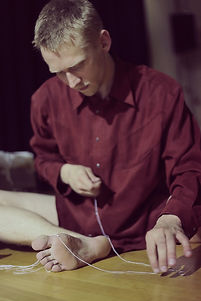

For some time I worked with gathering as a core interest — as a choreographic and political gesture through which temporary forms of relation can emerge. I was drawn to the idea that performance could function as a shared fiction, and that the audience could become more than receivers: that it could operate as a collective body capable of its own forms of attention and response. These concerns are present in much current thinking around live gathering, prefiguration, and the politics of performance.
What began to feel insufficient was the tendency to treat gathering itself as inherently generative or emancipatory. The forms through which I speak about disruption, horizontality, and being-together can become recognisable and reproducible, even when the actual conditions of a situation remain unchanged. At a certain point, the aesthetics of resistance risk circulating independently of any lived necessity.
I start from a turn toward what resists. I turn toward the structures that already organise bodies, attention, and relation before any gathering or dance begins. In theatre, I turn toward the tribune. As a social and perceptual technology that positions people as usually the first spacial contract in theatre. And I include myself in this turning. My own trained body, my habits of voice and presence, my desire to host and to make something happen - these too are obstacles. Language. They shape what can appear.
Obstacles, in this sense, are not failures. They are what allow perception to appear as perception - what slow things down enough for the contracts of architecture, linguistics, habit, and attention to become felt.
The work does not aim to resolve these tensions. It attempts to keep them active long enough for something to become perceptible in the body, in language, and in the relations that form between people in a room.
This workbook is an attempt to stay with that tracking.
It treats gathering as a site where care and coercion, belief and suspicion, intimacy and estrangement are constantly renegotiated - often without anyone fully deciding. It asks what kind of audience we might need today, as a practical and embodied one: friction that already exists between bodies, architectures, and inherited ways of being together.


The Apparatus
Everything circulates through systems of exchange and visibility.
Relationality itself appears increasingly organized through instruction, positionalities, optimization, and management - as if bodies and attention can simply be engineered into existence through enough pressure and direction. But something in reality resists decree. The body like a plant unfolds through conditions, atmosphere, relation, and time. I try to stay with this unfolding. At the same time questioning if today life actually works like that.. as consumption and programming of algorithms that completely bypasses the body.
Im driven by a highly critical, continuous movement across four distinct operational states. Each state acts as a specific agency to unpack the hidden mechanisms of choreographer and the audience relational presence in the space:
[ Researcher ] ──► [ Archiver ] ──► [ Witness ] ──► [ Performing Body ]
Systemic, and Contextual. / Perceptual, and Relational. /
Collective, and Documental. / Interruption and Friction /
-------------------------------------------------------------------------------------------------
Imagine entering a space where the seating itself is already watching you.
Before you have time to consciously process anything, the architecture has positioned your body, directed your gaze, and begun to shape the modalities of attention. This is where my research begins.
The work converts voice, language, communication, regimes of consent, the dialectic of rest vs. exhaustion , negotiation, and questioning of what or who's the Body in the space as live materials. Through their deployment, the practice actively unpacks the theatrical conventions and invisible contracts that govern performance, treating human behavior as raw, unstable and volatile matter in the room.
I create an environment in which the tribune, the bodies, and the structures of visibility are closely interconnected. Within this ecology-architecture, the tribune functions as the central object and primary material of a shared fiction.
The Anatomy of the Tribune: Etymological Sidekick & Spatial Imagery
Tribune: From the Latin tribunus (the heads of the tribes) and tribunal, the structure historically designates an elevated wooden or stone dais from which magistrates, judges, and emperors delivered decrees. A spatial technology engineered for vertical hierarchy. Yet a tribune was also the Roman official elected to protect the plebeian class from patrician overreach. It is a modular architecture of authority and gathering that inherently determines how bodies assemble, orient, and look.
The word itself carries a ghost -> contradictory, layered, alive. This doubleness is the precise site of friction. By placing the audience onto a structure saturated with this history of judgment, classification, and engineered focus, the physical practise tests the friction of the setup.
To make visible exactly what is being challenged in the studio, the research must expose the architectural and historical ghost built into the word. As a complex social machine carrying deeply entrenched, historical connotations:
Can this platform of governance be subverted if the performing body treats it as a live, unstable partner? In the context of MA body-based research, I challenge the audience as the solo body of the work - a collective yet singular entity whose attention and relational contracts are actively re-formed.
Design vs Accident
What perceptual and relational instabilities emerge when this double position is questioned?
My practice treats the performance environment as live machinery. Attention is actively formed, always becoming. I catch the architectural apparatus in the act of constructing experience before it solidifies into normative habits.
The work is especially interested in the moment when power manages bodies not through direct force, but through comfort, predictability, and exhaustion. Stability is treated here as an active and temporary negotiation held between bodies. To confront this paradox, the artistic positioning continuously slides along a shifting spectrum: researcher, archiver, witness, performing body.
Locating the Practice;
Core Questions
How is the spectator produced as a perceiving body in the first place?
What kinds of social relations emerge when an architecture - composed of bodies, voice, language, and shifting proximity - is already acting on us?
Where does the vertical hierarchy soften into horizontal co-presence? At what point does the engineered gaze fracture into multiple, unstable lines of flight?
The research exposes these architectural ghosts precisely so they can be inhabited differently - not erased, but activated as material for resistance against normative striations of attention, consent and care.


modalities of attention
anatomy-based arrangement of resources >
interface through which the nervous system meets the spatial apparatus. Apparatus of external movement and curation of the space.
Four distinct modalities, tracking how they are systematically formed and how they can be subverted through bodily intervention.
-- Peripheral Infiltration / Ambient Disturbance
As Archiver
Attention becomes multi-directional and environmental, transforming the room from an objective viewing arena into a live, unpredictable and unapologetic ecology.
How does the audience deliberately compose disturbance and negotiation as material?
--Visceral Echo (Involuntary / Autonomic Resonance)
As Witness
Attention drops from the eyes down into the spectator's throat, lungs, and soles.
Where does the work speak directly to the nervous system?
--Stratified Attention
As Researcher
Attention becomes an active, muscular act of negotiation - a conscious layering of inputs where no single layer holds absolute authority. How to keep multiple layers of attention in friction?
--The Architectural Baseline
As a Performing Body
self-regulating receiving apparatus. How does the work make this baseline perceptible?


Micro-political Myths & Embodied Transmission
A micro-political myth is the smallest social fiction that can pass from one body to another and change the reading of a room or the meaning of a shared belief. It is not yet law, but it already shapes subjectivity, relation, attention, and response. It moves as a rumor, an overheard sentence, a warning, a repeated phrase without author — a tiny script for behavior that people inherit before they know they have inherited it.
These myths are unstable. They carry a flirtation between something recognizable and something strange. Intimacy can appear inside alienation. They do not operate first through agreement or rational conviction. They operate affectively and relationally. People begin sensing how to behave before they consciously know what they believe.
My work collects and composes these small contagious forms. The goal is lightness in the importance of finding resistance and relationality with the environment. The environment itself becomes political through these transmissions. Embodied transmission travels body-to-body without instruction: ways of sensing danger, how to behave in a crowd, rhythms of intimacy and distance, gestures of care, shame, fear, attraction, authority, avoidance, belonging. A child learns them by watching bodies orient toward one another long before understanding language conceptually. Certain movements and momentums survive because they keep circulating body-to-body through lived situations.
Choreography continues after the performance ends when the work has entered collective behavior - when impact enters inside the skin and programs itself into the system of relations and associations of the world.
The Wolf's Hour - the treshold
in latin Hora Lupi and estonian Hunditund.
Historically and in Blatic’s folklore, the wolf’s hour names that old interval right before dawn - specifically the 4:00 to 5:00 AM matrix. It is the hour of the animal, where nightmares are most vivid, where the boundary between the real body and the ghostly other wears away. It is a moment of material mutation, where the architecture of a space becomes unstable, and the body no longer easily separates fear from pleasure, intimacy from spectacle, or sincerity from repetition. The stomach softens. A forest appears behind the eyes. You do not know whether you are fully awake or trapped in sleep paralysis.
Wolves live in the threshold between forest and human settlement, wild and social, predator and pack member. They embodie both collective intelligence and radical singularity. In the Baltic region, wolves carry strong symbolic charge - both dangerous outsiders and figures of protection or prophecy; Geopolitically, the wolf is read as a figure of the peripheral or marginal entering the centre. I take it as a force that can infiltrate and transform ordered space. Experimenting with voice and resonance. As a qualitative, atmospheric, nervous-system time - a duration measured in states of vulnerability.
–> The research adopts the Wolf’s Hour as threshold logic: an interval of transformation between stability and collapse. Bodies remain sufficiently oriented to recognise one another, yet not enough to fully know where they stand. Within this interval, voice and resonance function as conceptual tools to track the breakdown of normative habits.
Experimenting with voice and resonance, the throat becomes the site where this threshold happens: where one body produces multiple voices, where the mouth and throat physically form around what can and cannot yet be spoken, where the involuntary (inhale) meets neurodiverse polyphony, and where the audience is asked to participate in the return from that state. Here the body moves through the howl, the crawl, the sniff, and the bite --> feral micro-actions that surface when habitual transmissions begins to dissolve.
_____________________________________________________________
WOLF-VOICE PRAXIS: honoring grief, gravity and finding strategies for solving fictional catastrophes.
-
Teeth and heart TCM connection. (mouth/throat/heart axis)
-
Inhale Language
-
Throat as threshold
-
Nervous-system time
-
Material mutation
-
Sleep paralysis voice
-
Two- and three-voiced emergence
-
Involuntary speech
-
Audience as waking agent
-
Collective singularity
-
60-second threshold
-
Swallowed language
-
Edge-dwelling resonance
-
Polyphonic dissonance
-
Return from the threshold
Attention operates here as political material that is managed before conscious awareness catches up to it. Choreography can question these invisible contracts not by breaking them entirely, but by slightly displacing them: delaying response, redistributing focus, and allowing uncertainty to circulate longer than comfort usually permits. The audience stops functioning as a receiving structure and starts behaving like weather: unpredictable, moving through collective imagination, projection, and anticipation.

@ Uferstudios gate - badstrasse

Glossary
Conceptual tools to track the breakdown of normative habits.
Apparatus ( Dispositif )
The heterogeneous network of architectural layouts, linguistic instructions, institutional regulations.
The apparatus establishes the unwritten contract of a space, managing attention by structuring the physical field before the body can consciously process its environment.
Threshold
Borderland where stability meets collapse. In this research, the threshold is the precise physical or psychological zone where instructions fail to regulate behavior, allowing alternative, unauthorized socialites to leak through.
Body without Attention
The physical state achieved when the body breaks away from its socially assigned functions, predictable postures, and anatomical habits. Produced by exhausting the normative motor patterns of the mouth, transforming the body into an intense, unmapped landscape of speed, vibration, and raw sensation of movement.
Inhale Language
treats breath as the first involuntary point of relation. Speech is swallowed, interrupted, and physically blocked, forcing a voice through the mechanics of a gasping or labouring body until language ceases to function as a tool for detached commentary; instead, the room is inhaled - its atmosphere, its sound, its governance - infiltrating the politics of consent at the level of the autonomic nervous system.
Tribunal Dances
reimagines the haunted, hierarchical arrangement of the tribune as a site of collective choreography. Through subtle waves of weight and micro-adjustments in orientation, the seating structure is transformed into an active, relational body that responds to the hidden governance structures already present in collective perception.
Sewing the Dead Skin of the Feet
Vulnerability practice that addresses the exact sites of contact and exhaustion. Through slow, repetitive gestures of repair, it attends to the worn and calloused surfaces where the body meets the ground, suggesting that connection is a mechanism that must be continuously and physically maintained.
Kinking
introduces small, resistant bends into otherwise smooth and predictable systems. Working directly with the architecture of the tribune, it creates structural malfunctions in posture, timing, and attention, making visible the tiny negotiations of agency that become possible when a structure that precedes us is gently disturbed from within.


Epistemology: The Unbroken Research Chain
The research proceeds by moving between different modes of engagement without collapsing them into a single coherent position. What is produced in one mode is not immediately translated into another. It is held in tension and permitted to shift.
This movement is not a method for accumulating understanding. It is a way of keeping the research responsive to what continues to exceed the frames already applied to it. The value of the process lies in the capacity to remain in contact with the material without converting it too quickly into concepts or forms that render it usable.
The chain remains unbroken because it refuses to treat friction as something to be resolved. Instead, it treats friction as the condition through which the work continues to register what is at stake.
when language begins to return, texts emerge from real and imaginary encounters. These sentences often come from everyday language that has lost its original weight or meaning.
chosen Audience TEXT SCORES.
TEXT / WORDS / AIR
Oh my God
OH. MY God
My God
Your God
My God does not approve this situation right here, right now, okay?
Your God does not accept this situation.
Who woke me up?
Woke. - up?
Who do you think you are?
Do you think you'r my mother?
Finee, I can also be your mother.
I can be all of your mothers.
Darling, you've grown so old already..
It's lovely. .... It's Amazing.
Its a jungle out there...
Who's in charge here ?
Spoken with the inhale voice. This layer is directly addressed to the audience, especially those who participated in waking the performer. It functions as a kind of contract. Through the inhale voice, the Mother text takes on a theatrical quality, creating a shared fiction that the audience is invited to enter and play with.
emergency converstation with one audience member. / Reality check of before and now. How were you choreographed to come here? To this platform. (dialog call named ' How?')
How did you got here?
How exactly are we doing?
How many heads do you see?
How did you do it?
How was is before, did you come?
How are you. Whats up? What are you up to. What are you up to?..
Registers of conversations with myself - as the host: smth that really matters;
* how to leave the space and consider the time here.
* ignorance of culture and violence.
* my brother, who never goes to theatre or travels outside his home country.
* care ; attention and blindspots of us coming together.
hosting voice. >>These texts move between private reflection and public address. They are less concerned with being immediately understandable. Instead, they explore what it means to speak about something that matters while remaining in a vulnerable state. The interest lies in the tension between the content and the body that is speaking it. Registers.
The performer shifts between these two layers in one continuous flow, playing with delay and self-surprise. This movement allows the relations to travel between intimate and social, private and public modes of being present.
The Collaborative Log
Dialog with mentor:
An audience becomes a body when spectators begin unconsciously reading one another while watching. In that moment, they stop functioning as isolated observers and start operating as a sensitive social organism, continuously reorganizing itself through peripheral signals and small imitations. The room acquires a shared nervous system.
Engagement and disturbance are not opposites. They are partners. The work moves in the anxious space between them - where the spectator is both held and slightly unsettled, both inside the event and aware of its constructed nature.
If the audience is the solo subject of the work, then the entire viewing structure becomes a live apparatus that asserts its own governance through self-awareness. It stops being a passive collection of onlookers and becomes a self-made collective body.
A child watching a magic trick exists on a threshold where belief and disbelief are held in suspension at the same time. They know the ball did not actually disappear, yet experientially a shift in perception has occurred. There is dignity in that specific suspension. The work is interested in this kind of relation - one that requires both immersion and distance.
Attention requires choreography. Belief requires technique. A magician does not practice only to deceive, but to create conditions in which another person willingly enters a different mode of sensing. What techniques are needed here so that the gathering can be experienced as something larger than the sum of its individual parts?
You do not need to break the inherited contracts of spectatorship. It is enough to introduce a slight misalignment or a delay. When uncertainty is allowed to circulate longer than usual comfort permits, the audience can shift from a static receiving structure and begin behaving like weather - unpredictable, moving through collective imagination, projection, and anticipation.
We are organizing a temporary settlement on these wooden platforms. The question is not what grand cosmology we gather around, but what temporary meaning and shared duration we are willing to sustain. When that organization begins to dissolve, what forms of movement and attention remain possible? That is why gathering still matters. It creates a brief zone in which alternative arrangements of sensing and coexisting can be rehearsed before they harden into fixed forms.
11.06.2026 Studio9 Presentation
The room is caught between catastrophe and suspension. People begin watching themselves watching. The nervous system can no longer separate fear from pleasure, intimacy from spectacle, sincerity from representation. Incomplete, hungry and infiltrating.
In an era of frictionless consent _.> Wolf's Hour investigates a threshold between stability and collapse. The work unfolds within the unwritten contract between performer, audience, and architecture. As a modular structure of authority and gathering, the tribune determines how bodies assemble, orient, and look.
The research tests the friction of this setup. Through physical attempts to stitch together forms of belonging under pressure - only to tear them apart - the work asks what relations remain possible as the room continuously builds and disrupts its own orientation. A shifting negotiation between those who watch, those who are watched, and the structures that bind them together.
